
Job Posting Playbook
Introduction
Your job posting is often the first impression candidates have of your company and the role you are hiring for. A poorly written or badly distributed job posting will fail to attract qualified candidates, waste your recruiting budget, and extend your time-to-hire. Conversely, a well-crafted job posting can significantly increase the quantity and quality of applications you receive.
This playbook provides a comprehensive guide to creating and distributing effective job postings. You will learn how to write compelling job descriptions, choose the right job titles, structure your content for maximum impact, select the best distribution channels, and measure the performance of your postings.
Whether you are posting your first job or looking to improve the effectiveness of your recruiting campaigns, this playbook offers practical strategies that work for companies of all sizes.
Writing Effective Job Descriptions
The job description is the core of your posting. It must be clear, accurate, and compelling enough to motivate qualified candidates to apply while setting realistic expectations about the role.
Start by understanding your audience. Who are you trying to reach? What motivates them? What language and tone will resonate with them? A job posting for a creative role should sound different from one for an engineering or finance position.
Be specific about what the person will actually do. Avoid generic phrases like "responsibilities include various tasks" or "other duties as assigned." Instead, describe the day-to-day work, the problems they will solve, and the impact they will have. Specificity helps candidates self-select and reduces mismatched applications.
Focus on outcomes, not just tasks. Rather than saying "manage social media accounts," say "grow our social media following by creating engaging content and building relationships with our online community." Outcomes give candidates a sense of purpose and help them envision themselves succeeding in the role.
Balance requirements with realism. Many job postings list unrealistic combinations of skills or excessive years of experience. This discourages qualified candidates from applying, particularly underrepresented groups who tend to apply only when they meet 100% of requirements. Distinguish between must-have skills and nice-to-have skills.
Use inclusive language. Avoid gendered terms, jargon, or phrases that may discourage diverse candidates. Research shows that job postings with masculine-coded language (such as "dominant," "competitive," "rockstar") receive fewer applications from women, while neutral or inclusive language increases diversity in the applicant pool.
Sell your company and the opportunity. Candidates want to know why they should work for you. Include information about your mission, culture, team, growth opportunities, and benefits. Make them excited about the possibility of joining your organization.
Job Title Strategy
The job title is the single most important element of your job posting for searchability and attracting the right candidates. A creative or unclear job title may reflect your company culture, but it can severely limit the number of people who find and apply to your posting.
Use industry-standard job titles whenever possible. Candidates search for jobs using common titles like "Software Engineer," "Marketing Manager," or "Sales Representative." If your internal title is "Coding Wizard" or "Growth Hacker," consider using a standard title in the posting and noting the internal title separately.
Be specific about the level of the role. Titles like "Senior Software Engineer" or "Junior Marketing Coordinator" help candidates immediately understand whether the role matches their experience level. Ambiguous titles waste time for both you and applicants.
Avoid internal jargon or company-specific titles that candidates outside your organization would not recognize. If your company uses unique titles, translate them into standard equivalents for the job posting.
Consider SEO and searchability. Job boards and search engines prioritize common job titles. Using nonstandard titles can bury your posting in search results and dramatically reduce visibility.
That said, if your company brand is strong and you are targeting a specific niche audience, a creative title might work. Just be aware of the trade-offs and test different approaches to see what generates the best results.
Structuring Your Job Posting
A well-structured job posting is easy to scan, highlights the most important information, and guides the candidate toward applying. Use a clear structure that candidates expect to see.
Begin with a brief company overview. In two to three sentences, explain what your company does, your mission, and what makes you unique. This is your elevator pitch to candidates.
Follow with a role summary. In one paragraph, describe the role at a high level: what the person will do, who they will work with, and why the role matters. This helps candidates quickly determine if they are interested.
List key responsibilities in bullet points. Aim for five to eight responsibilities that represent the core work. Start each bullet point with an action verb and be specific about what the person will do.
Separate required qualifications from preferred qualifications. Required qualifications are the absolute must-haves without which someone cannot succeed in the role. Preferred qualifications are nice-to-haves that would make a candidate stronger but are not deal-breakers.
Include information about compensation and benefits if possible. Salary transparency is increasingly expected and legally required in some regions. Even if you cannot list an exact salary, providing a range or mentioning competitive compensation helps set expectations.
Describe your team and work environment. Help candidates understand who they will work with, whether the role is remote or in-office, and what a typical day looks like.
End with clear application instructions. Tell candidates exactly how to apply, what materials to submit, and what to expect next. Simplify the application process as much as possible to reduce drop-off.
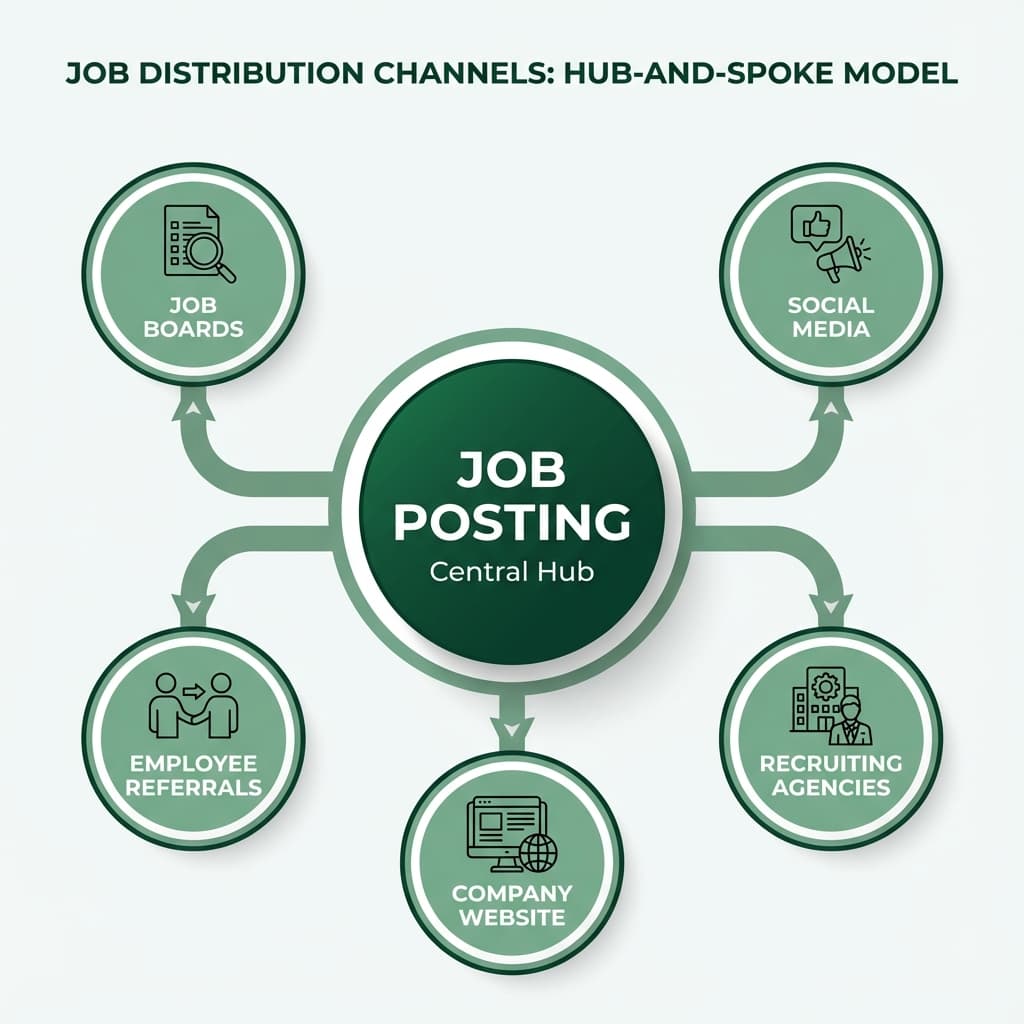
Distribution Channels
Once you have written a strong job posting, you need to distribute it where your target candidates will see it. Different channels work better for different roles, industries, and candidate demographics.
General job boards like Indeed, Glassdoor, and LinkedIn are essential for most roles. They have large audiences and strong SEO, making your posting discoverable to active job seekers. However, competition is high, and your posting may get lost among thousands of others.
Niche job boards cater to specific industries, roles, or demographics. Examples include Stack Overflow for developers, Behance for designers, and AngelList for startup roles. Niche boards typically have higher-quality candidates and less competition.
Your company website and career page should always host your job postings. This allows candidates who are specifically interested in your company to find openings and provides a branded experience.
Social media platforms are increasingly important for job distribution. LinkedIn is the most popular for professional roles, but platforms like Twitter, Facebook, and even Instagram can be effective depending on your audience. Some recruiting platforms help teams distribute job postings across multiple channels simultaneously, such as Flowxtra. For detailed strategies, see our Social Media Recruiting Playbook.
Employee referral programs leverage your team's networks to find candidates. Encourage employees to share your job postings with their connections by making it easy to share and offering incentives for successful hires.
Recruiting agencies and headhunters can be valuable for hard-to-fill roles or when you need to move quickly. They have access to passive candidates and can handle much of the sourcing and screening work.
Optimization and SEO
Job posting SEO ensures your postings appear in search results when candidates search for relevant roles. Optimization involves using the right keywords, structuring your content properly, and following best practices for job boards and search engines.
Use relevant keywords throughout your posting, particularly in the job title, summary, and responsibilities sections. Think about what terms candidates would search for when looking for this type of role.
Include location information clearly. Many candidates search for jobs by location, so make sure the city, state, and country are easy to identify. If the role is remote, explicitly state that in the title and description.
Keep your posting updated. Job boards and search engines prioritize recent postings, so refresh your posting periodically to maintain visibility. Even small edits can bump your posting back to the top of search results.
Use structured data markup if you are posting jobs on your website. Schema.org JobPosting markup helps search engines understand your job postings and can result in enhanced search listings.
Write unique postings for each role. Avoid copying and pasting the same generic description for multiple positions. Unique content performs better in search rankings and provides a better candidate experience.
Monitor which keywords and channels drive the most applications. Use this data to refine your postings and distribution strategy over time. For more on tracking and analytics, see our guide on job distribution.
Measuring Performance
To improve your job postings over time, you need to measure their performance and analyze what works and what does not. Key metrics include the number of applications, the quality of applications, time-to-fill, and cost-per-hire.
Track the number of applications each posting generates. Low application volume may indicate poor visibility, an unappealing job description, or an overly narrow set of requirements.
Assess the quality of applications. Are you receiving applications from candidates who meet your requirements? High volume with low quality suggests your posting is attracting the wrong audience or your requirements are unclear.
Measure which channels generate the most and best applications. This helps you allocate your recruiting budget effectively and focus on the channels that deliver results.
Monitor time-to-fill for each role. Long time-to-fill may indicate that your posting is not reaching enough candidates or that your job description is not compelling.
Calculate cost-per-hire by dividing your total recruiting costs by the number of hires. This helps you understand the ROI of different distribution channels and posting strategies.
Gather feedback from candidates and hiring managers. Ask candidates what attracted them to the role or what concerns they had. Ask hiring managers if the candidates they interviewed matched the job description.
Test different versions of your postings to see what performs best. Experiment with different job titles, descriptions, structures, and channels. Use A/B testing when possible to isolate the impact of individual changes.
Common Mistakes to Avoid
Even experienced recruiters make mistakes when creating and distributing job postings. Here are the most common pitfalls and how to avoid them.
Unrealistic requirements: Listing excessive qualifications or impossible combinations of skills discourages qualified candidates from applying. Be honest about what is truly required versus what is merely preferred.
Generic job descriptions: Copying templates or using vague language makes your posting blend in with thousands of others. Invest time in writing a unique, specific description that reflects the actual role and your company culture.
Ignoring mobile users: Many candidates search and apply for jobs on mobile devices. If your job posting or application process is not mobile-friendly, you will lose a significant portion of potential applicants.
Poor application process: Requiring candidates to create an account, complete lengthy forms, or upload multiple documents dramatically increases drop-off. Simplify the application process as much as possible.
Inconsistent messaging: If your job posting describes a collaborative environment but your interview process is impersonal or your Glassdoor reviews mention a toxic culture, candidates will notice the disconnect. Ensure your posting accurately reflects reality.
Posting and forgetting: Simply posting a job and waiting for applications is rarely effective. Actively promote your posting, engage with candidates, and refresh the posting regularly to maintain visibility.
Neglecting employer brand: Your job posting is a reflection of your company. Sloppy writing, typos, or an uninspiring description damages your employer brand and makes top candidates less likely to apply.
Job Posting Checklist
Use this checklist to create and distribute effective job postings:
- Use a clear, industry-standard job title
- Write a compelling company overview
- Include a concise role summary
- List 5-8 specific key responsibilities
- Separate required and preferred qualifications
- Use inclusive, accessible language
- Include information about compensation and benefits
- Describe the team and work environment
- Provide clear application instructions
- Optimize for SEO with relevant keywords
- Distribute to multiple relevant channels
- Ensure the application process is mobile-friendly
- Track performance metrics
- Refresh the posting regularly
Frequently Asked Questions
Should I include salary information in the job posting?
Yes, when possible. Salary transparency helps set expectations, attracts candidates whose expectations align with your budget, and is legally required in some regions. If you cannot list an exact salary, consider providing a range.
How long should a job posting be?
Most effective job postings are between 300 and 800 words. Shorter postings may lack necessary detail, while longer postings risk losing the reader's attention. Focus on clarity and relevance rather than length.
How often should I refresh my job posting?
Refresh your posting every one to two weeks to maintain visibility on job boards. Even small edits can bump your posting to the top of search results and signal to candidates that the position is still active.
Should I use the same job posting across all channels?
While the core content should be consistent, consider tailoring the tone or format slightly for different channels. A LinkedIn posting might be more formal, while a social media post might be more casual and engaging.
What if I am not getting enough applications?
Revisit your job title to ensure it is searchable, expand your distribution channels, simplify your application process, review your requirements to ensure they are realistic, and consider increasing compensation or offering remote work if possible.
What to Do Next
Now that you understand how to create and distribute effective job postings, take these next steps:
- Audit your current job postings and identify areas for improvement
- Rewrite your most important job postings using the structure and best practices outlined in this playbook
- Expand your distribution strategy to include channels you have not tried before
- Implement tracking to measure the performance of your postings
- Explore related topics such as recruiting workflows and social media recruiting
Creating great job postings is both an art and a science. Continuously test, measure, and refine your approach to improve results over time.