
Hiring Automation Playbook
Introduction
Recruiting involves many repetitive, time-consuming tasks. Automation can free recruiting teams from administrative burden and allow them to focus on finding and attracting great talent.
However, automation is a double-edged sword. Used thoughtfully, it improves efficiency and candidate experience. Used carelessly, it creates impersonal processes and can introduce bias.
What to Automate
Good candidates for automation include: job posting distribution, application acknowledgment, status updates, interview reminders, candidate nurturing, data entry, and reporting.
What Not to Automate
Keep these tasks manual: initial candidate outreach, interview conversations, hiring decisions, rejection communication for interviewed candidates, negotiation and offer discussions, and handling sensitive situations.
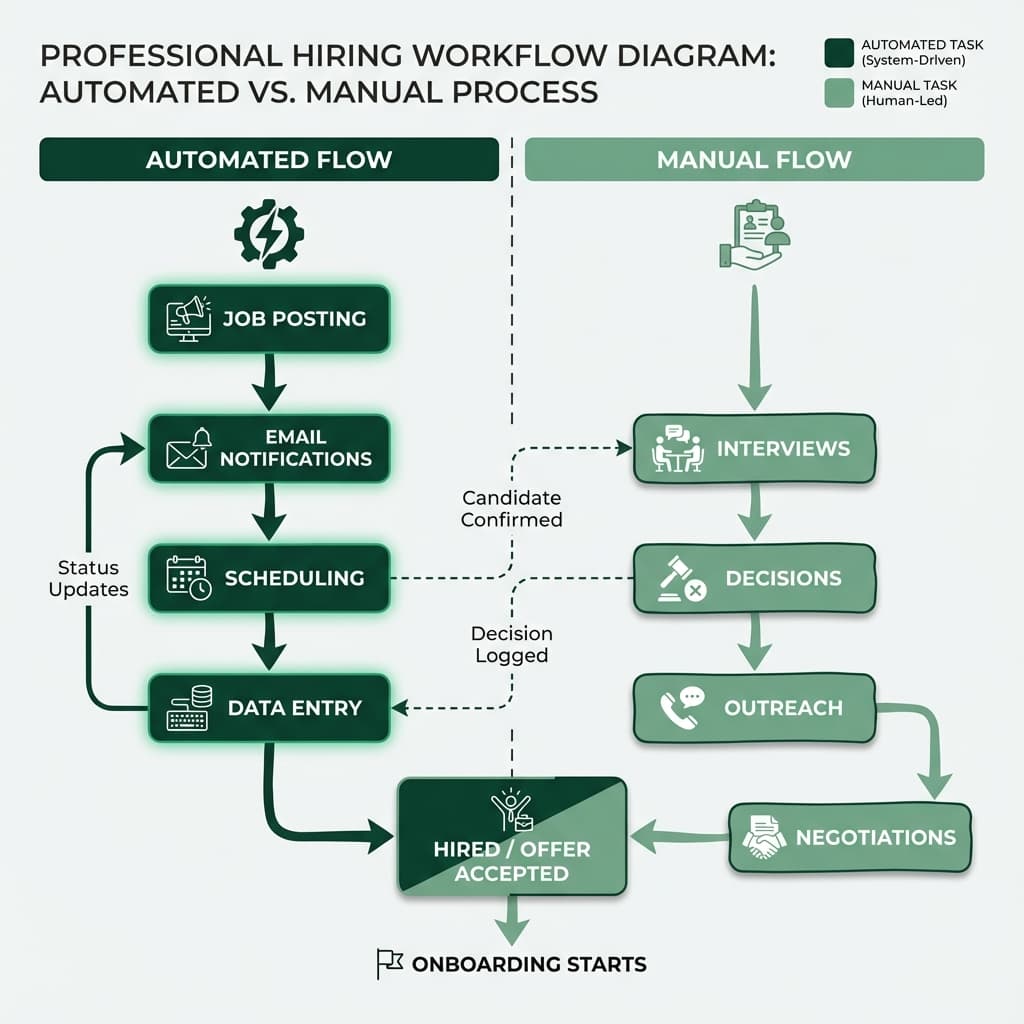
Automated Job Posting
Modern recruiting platforms allow you to create a job posting once and automatically distribute it to dozens of channels. This ensures consistency and saves significant time. Some hiring software solutions provide automated multi-channel distribution, such as Flowxtra.
For more details, see our Job Posting Playbook.
Automated Candidate Screening
Automation tools include resume parsing (extracting information automatically), knockout questions (filtering based on basic requirements), automated scoring (ranking candidates), skills assessments, and AI-powered screening.
These must be monitored carefully to avoid bias. For more, see our guide on candidate screening.
Communication Automation
Automate acknowledgment emails, stage transition emails, interview reminders, early-stage rejection emails, and drip campaigns for passive candidates. Focus on clarity, tone, and usefulness.
Interview Scheduling Automation
Self-service scheduling allows candidates to view available time slots and book their own interview. Calendar integration checks availability automatically. Automated confirmations and reminders reduce no-shows.
AI in Recruiting
AI capabilities include sourcing tools, resume screening, chatbots, interview intelligence, and predictive analytics. When implementing AI, prioritize transparency, fairness, and human oversight. Regularly audit for bias.
Common Mistakes
- Over-automating: Keep human involvement in key moments
- Poor communication tone: Write natural-sounding templates
- Set it and forget it: Regularly review and update
- Ignoring edge cases: Have processes for exceptions
- Lack of testing: Test everything before going live
- No human oversight: Build in review checkpoints
What to Do Next
- Audit your recruiting process and identify time-consuming tasks
- Prioritize which tasks to automate based on impact
- Research automation tools that integrate with your systems (see our ATS playbook)
- Start with one simple automation
- Test thoroughly and gather feedback
- Explore hiring automation strategies
- Review your overall hiring process